Congratulations to Anne Schwager, Jonas Neipel, Yahor Savich, Douglas Diehl and their colleagues on their new paper in PNAS!
How does a transcription factor recognise DNA sequences across the human genome? Although transcription factors are known to recognise specific DNA motifs, they also bind to many other sequences with varying affinities. Understanding these interactions is essential for predicting where proteins bind to DNA.
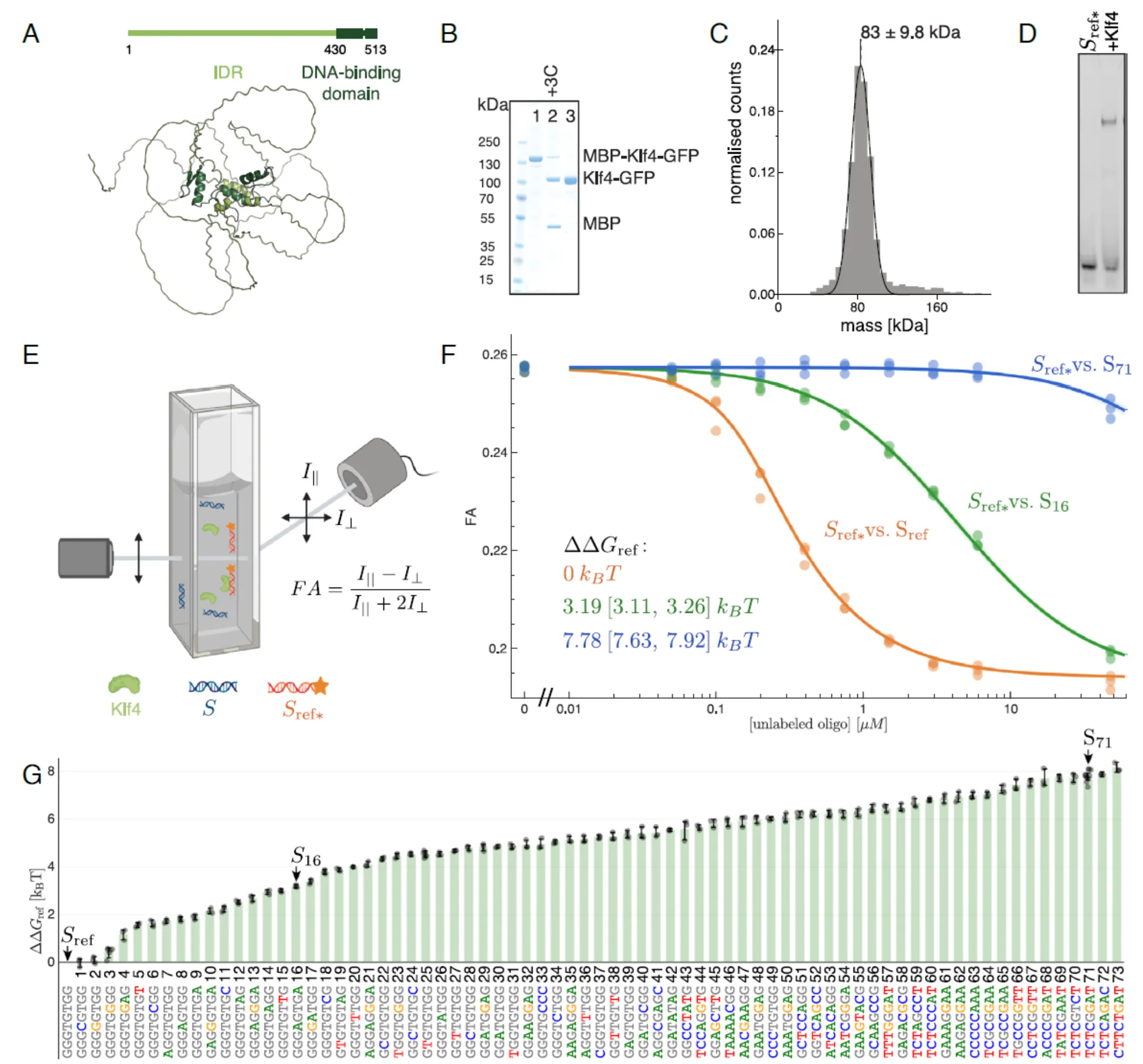
In a collaboration between the Hyman, Jülicher and Grill labs, Anne developed a quantitative assay to measure the binding energies of the human transcription factor Klf4. Using a library of 73 systematically varied DNA sequences, she was able to measure affinities spanning a remarkable 3000-fold range, including very weak interactions that are normally difficult to quantify.
The measurements revealed a strongly nonlinear dependence on DNA sequence. To explain this, Jonas and Yahor developed a statistical-mechanical model in which neighbouring nucleotide–protein interactions are coupled, allowing transitions between weak and strong binding states.
Remarkably, the model, based entirely on these in vitro measurements, could predict Klf4 binding in independent single-molecule experiments performed by Douglas Diehl, and quantitatively predict occupancy across the human genome without additional fitting parameters.
This is a great example of how quantitative experiments and physical theory can work together to uncover principles of molecular recognition, allowing us to predict behaviour from individual DNA sequences to the scale of an entire genome.
Congratulations to everyone involved!
Check out the original paper: https://doi.org/10.1073/pnas.2538133123.