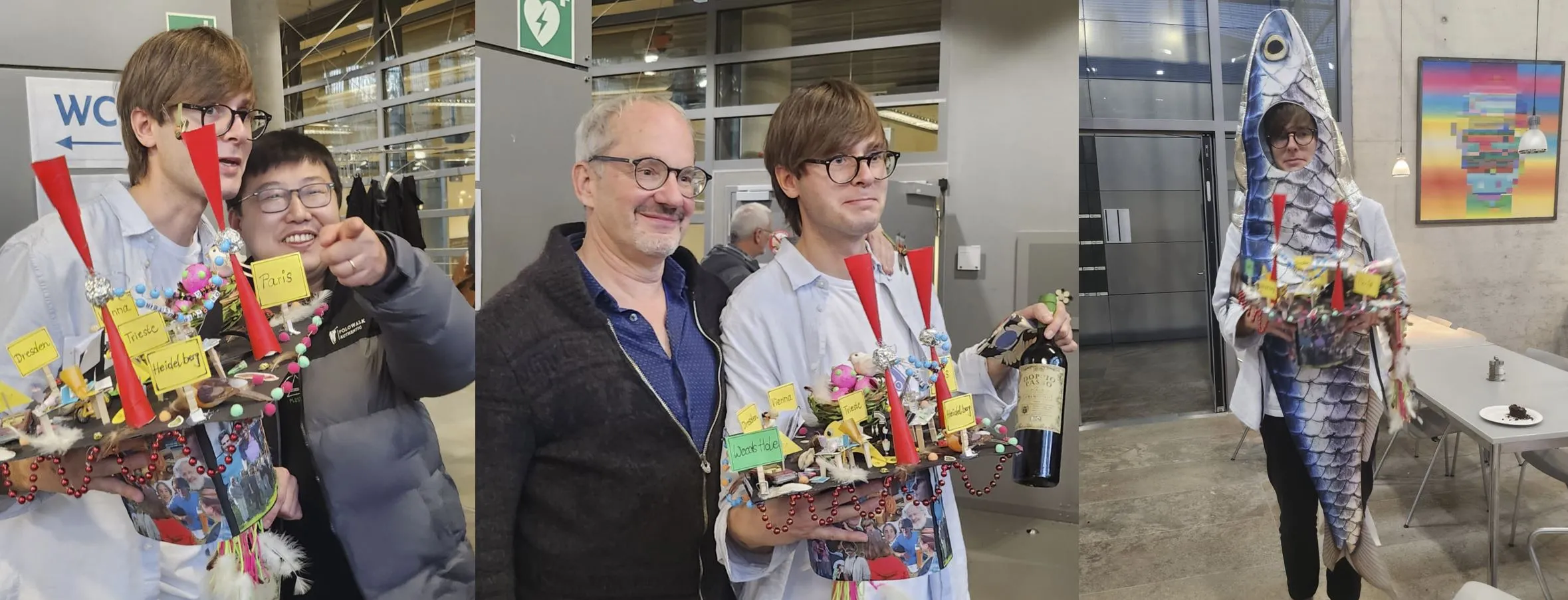
David Kuster (@rnadavid.bsky.social), whose research centers on RNA and its roles in metabolism, catalysis, and the spatial organization of cells, successfully defended his PhD with summa cum laude honors.
During his PhD, David focused on RNA-binding proteins (RBPs) with pivotal roles in disease. Using in vitro reconstitution approaches, he demonstrated that TDP-43—an RBP frequently found aggregated in neurodegenerative disease—undergoes intra-condensate demixing within stress-granule condensates composed of G3BP1 and RNA, in a redox-sensitive manner.
He further investigated the conformational adaptability of intrinsically disordered region (IDR)–containing RBPs, using the SARS-CoV-2 nucleocapsid protein as a model system. This work revealed how hyperphosphorylation of intrinsically disordered proteins can modulate the material properties and biological functions of large protein collectives within biomolecular condensates.
Beyond molecular condensates, David also bridged biological scales—from single-molecule measurements to single-bird observations in large flocks of geese and other species, often along the Elbe river. Some of this long-term bird monitoring even made it into Figure 1 of his thesis.
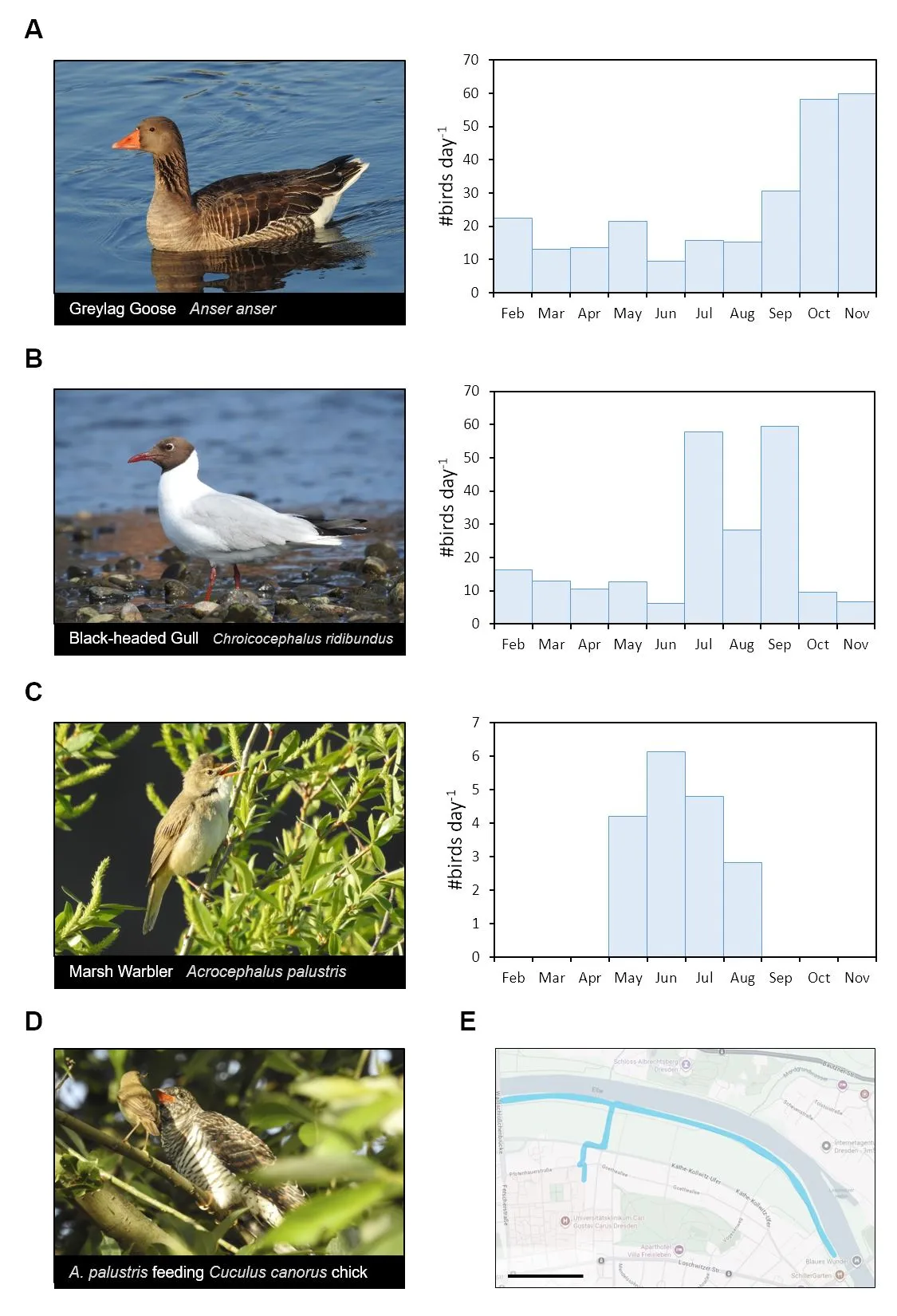
Figure 1. Average number of individual birds per day for each month of the year along the Elbe river adjacent to MPI-CBG. Shown are data for three of the 129 bird species observed by David over the last three years. (A) Greylag Geese Anser anser are resident year round with ~20 individuals per group, usually engaged in collective grazing, and higher numbers observed in the winter months. (B) Observed numbers of Black-headed Gulls Chroicocephalus ridibundus peak in summer, where they are mostly found resting on the shore or hunting in large flocks above the water. (C) Breeding pairs of Marsh Warbler Acrocephalus palustris are found vocalizing, nest building and chick raising along the Elbe river throughout the summer. (D) A. palustris pairs were frequently found to be targeted by the Common Cuckoo Cuculus canorus for brood parasitism. (E) Typical transect taken for monitoring of bird populations in the early morning in Dresden along the Elbe river. Scale bar, 0.5km
A wonderful example of curiosity-driven science across scales—congratulations again, Dr. Kuster! 🎉